Wednesday, August 5, 2015

Keyboard or Pen wasn’t the Question


It isn’t often I tackle “prevailing wisdom,” but this is one of those moments. While Pam Mueller and Daniel Oppenheimer certainly created a catchy title, The Pen is Mightier than the Keyboard, they omitted an extremely important fact–that note taking is an art to be taught and practiced. Maggy McGloin, writing in the HarvardBusiness Review, is perpetuating the omission, and, since the Harvard Business Review carries a certain cachet, I’m prepared to begin my journey. Thanks to Alfie Kohn for giving me the courage to speak. I was a huge fan and ardent practitioner of assigning homework to middle school students. After reading and thinking about Kohn’s work, I no longer assign nightly homework, opting instead to allow my students time to pursue their own hobbies and interests. But, I digress.

Mueller and Oppenheimer discovered that students who take notes on laptops often engage in mindless transcription. I have no doubt this is true. Learning to take notes requires practice and frequent reminders from instructors, teachers, and coaches. Educators already know we need to teach how to highlight material in texts. Left to their own devices, younger students develop the habit of highlighting anything they don’t know. They often try using different colors of highlighters for different pieces of information. Students tell me they use blue for new vocabulary, yellow for new facts, pink for new dates, etc. While their texts are quite colorful at the end, students don’t really absorb material and have no clue how to use the highlighted passages to study for quizzes or tests. Sports coaches give near constant feedback to athletes beginning in middle school. High school and college coaches continue this practice. How many high school teachers or college professors review individual student notes prior to midterms or unit exams?
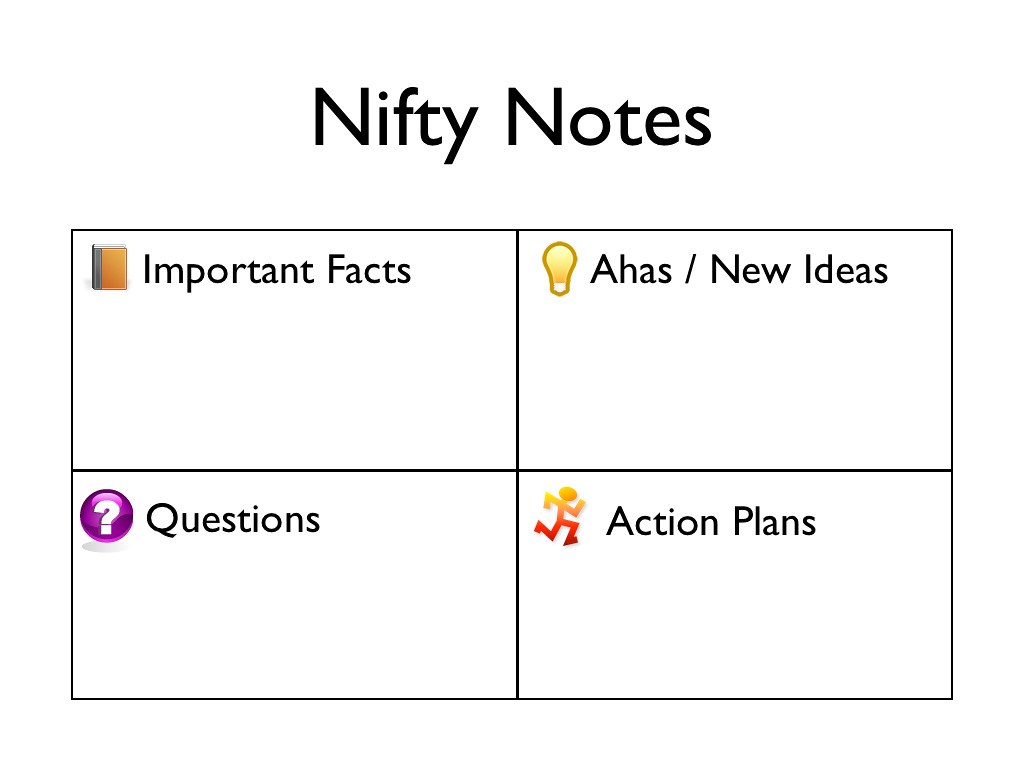
Note taking sheet
Learning to take notes requires the same focus and attention as learning to highlight text. Teachers use strategies such as the New AmericanLecture, Cornell Notes, and a host of others to help students learn how to take notes effectively. I find that I have to continually remind students to use organizers when taking notes. In middle school, I often give students organizers that have three bullets in each of four boxes. Students are instructed not to exceed three bullets.  Other times, I will use up to five bullets. The point is that students need note taking parameters. Left to their own devices, I agree with Mueller and Oppenheimer, students will mindlessly transcribe.

Part of my curriculum involves students taking notes while viewing videos. In order to reduce the temptation to transcribe the video, I send the students a link to a video transcript. They immediately understand they do not need to retype the transcript. It is available to them anytime they need it. Teaching note taking requires the same skills as teaching any other concept. Students need an introduction, opportunity to practice, and some form of feedback loop.

The question Mueller, Oppenheimer, and McGloin should have asked their college students is what note taking method they used and why they chose it. When I ask seventh graders this question, many reply they have no organized method, they just write bullets. I teach at least three methods of taking notes in my class. We begin with Cornell, outline, and mind mapping (mapping.)  I review which methods helped students and by the end of the year, I ask them to choose the method they have found the most helpful.
Students do not automatically remember these methods from year to year or class to class or even unit to unit within the same class. The temptation to revert to a new bullet for every note and mindlessly transcribe is often too great to resist. The reason note taking methods, even just longhand, work is that students have to mentally analyze and evaluate information prior to writing/typing it. Every teacher from middle school to university needs to instruct and remind students how to take useful notes.

Taking notes on a laptop is far more useful than longhand if taught and practiced correctly. Laptop notes can be annotated, tagged, re-used, shared with study groups, and, when cited correctly, become the basis for research articles, class papers, and essays. Electronic notes also encourage reorganizing, further research, etc., that both enhance and extend learning. Part of my teaching note taking methods involves students coming to class with at least three questions generated from their notes. These become the basis for a quick review/discussion. Muller’s and Oppenheimer’s study do not indicate any follow up other than a quiz.


Longhand notes might work well in the short term, either for a unit or a single class. Electronic notes will last longer and be far more useful provided students are taught/reminded that there has to be a method to their note taking. Mindless transcription is not a method, just as mindless text highlighting is not actively reading. Students should be explicitly coached how to take notes and encouraged to use the methods they have learned.  Pam Mueller agrees and, in a follow up interview, concludes, “Ultimately, the take-home message is that people should be more aware of how they are choosing to take notes, both in terms of the medium and the strategy.”  The question isn’t pixel or pen. It is which note taking method will help me learn and retain this material?


Image sources:
Keyboard & Pen
Nifty Notes
What's so Simple about Note-Taking
Keyboard toolbox


Saturday, December 27, 2014

How to Define and Measure Student Success

Recently, my students completed the oral presentations we call FAME, Feudal Asia, Medieval Europe.  This year, the presentation method of choice was video. It would be simplistic to conclude students chose video because they are part of the YouTube/Instagram generation.  Video is how they learn best.  But, I suspect there are two more complex factors at work, also.  Video production allows students to present without memorizing/planning remarks.  All they have to do is learn the specific scene each time and they are good to go.  Or, they create an RSA animation style video that involves a voiceover.  No one can see they are reading their remarks.  Video allows students to move beyond the classroom and school.  The entire city becomes their set.  This year students filmed at the Lan Su Chinese Garden, Fanno Creek, and Downtown Portland, just to name a few places I recognized from their videos.

As the project took shape I began to ponder success.  Students who had horrible material management skills were suddenly showing up with the appropriate costumes and props.  Time management issues disappeared as kids turned in essays on time.  I began thinking about how success really needed to be measured individually and not always culminate with some type of performance.  Additionally, children who adore gaming were creating review games using Kahoot!

My school, as are most, is filled with performances of all kinds.  We have drama performances, music performances, kids lead assemblies, language students perform poetry for their peers, etc.  We all compliment our colleagues after a performance concludes.  Yet, what if the success actually occurs prior to the performance?  The child who may only have one line demonstrates success by helping others learn their lines.  Yet, because they only speak once, their impact on the whole activity goes unnoticed by all but the most discerning adults.  A child, for example, who has never created a video executes a terrible video, yet they should receive accolades because they took the risk and created a video complete with shooting script, plot, variety of camera angles, costumes, and other complexities.  Their first video will win no prizes, it will go virtually unrecognized by anyone except their parents, yet it represents a huge achievement for the child. 


The success experienced by the beginner matches the achievement of the more able child, yet, the more able child is perhaps held to the same standard.  As the project facilitator, one of my tasks is to determine how to appropriately challenge the more able student so that their success represents as much growth as the beginner.  Now, my PE colleagues have this figured out.  During a fitness unit, students are tested at the beginning and end of the unit.  Most children show improvement as times drop or repetitions increase.  Oh, sure, I could give a pre-test and post-test, but this type of teaching rarely measures the skills necessary to find success in a project.  I am also not talking about differentiation, the current education buzzword to allow for learning differences/abilities in schools.  Measuring success is much more.  What if the child is never performance ready?  What if the work is never shared publicly?  Is it possible the process itself defines success?  Is it possible to celebrate process?  If so, what does that look?  Comments welcome!  Let’s continue the discussion. 

Sunday, May 4, 2014

Note–taking Revisited


A recent article from the Atlantic is sure to reignite the debate about taking notes by hand or using electronic aids such as laptops, tablets, or phones.  While the article is certainly an engaging and enjoyable read, the research behind the article is not only suspect, it simply ignores the whole body of knowledge around note–taking and learning styles.

Note–taking needs to be taught just as reading, writing, and scientific investigation need to be taught.  Telling students to take notes is probably worse than not saying anything because at least if a lecturer says nothing, the students might remember something interesting from the talk.

In Mueller and Oppenheimer’s study, there is no mention of how students were instructed to take notes.  Teachers already know students try to take verbatim notes, even when hand-writing them.  Laptops by themselves aren’t distracting.  Checking email, having the device beep, chirp, and notify users of everything from dental appointments to when their next class begins is certainly distracting.  I teach middle school, so students don’t usually take notes while viewing Game of Thrones at the same time.  Taking notes without reviewing the material afterwards has already been proven useless in countless studies dating back to at least the mid-nineties.  Whether electronic or hand written, students need to interact with their notes.  They need to rearrange the information into outlines, mind maps, or highlight one side of an argument in red, the other in blue.

The good folks who run high school and college learning/tutoring centers have a whole body of research devoted to this topic.  Consider the guidelines at the University of Minnesota Center for Teaching and Learning or the Note–Taking in the 21st Century Tips for Instructors and Students from Texas Tech University.

Many, if not most, teachers are facile with writing notes and, if older than 25, probably developed some type of handwritten note taking system.  Today’s students learn differently, organize information differently, and store information differently than their teachers did as youngsters.  How many teachers teach note–taking differently?  Inspiration!, one of the early mind-mapping applications seems to have come and gone, yet the idea of teaching kids to clump information has been proven to be far more effective for later recall/studying than bullet points or just writing random thoughts.  Schools using Google Apps for Education have access to mind-mapping add-ons, yet most students are still trying to take electronic notes using only typing skills in empty Google Docs.  Since teachers have little skill using modern note-taking tools such as Notability or Evernote, they are unable to teach these tools to students.

Thanks to advanced brain research, teachers are aware of differently intelligences and different learning styles.  That knowledge should inform how note–taking is taught.  For example, students could focus on a presentation that filled a board with information, take a picture of the board with their phone, then, when given 5 minutes to share with a classmate the implications of the presentation, could summarize and insert the photo into Google, Word, Evernote, etc. for easy access while reviewing the material.

Mueller and Oppenheimer proved that note–taking needs to be taught.  Perhaps the Atlantic article will help focus the spotlight on teaching students not just how to take notes, but how to organize, categorize, and utilize those notes combined the accompanying pictures, diagrams, and color-highlighted text to more effectively learn and access new material.

Works Cited 
Boye, Allison. "NOTE-TAKING IN THE 21st CENTURY: TIPS FOR INSTRUCTORS AND STUDENTS." Texas Tech University Teaching Resources. Texas Tech University, n.d. Web. 4 May 2014. <http://www.tlpd.ttu.edu/home/TLPDCTeachingResources/documents/Notetaking%20Whitepaper.pdf>. 
"Effective Handouts: Using PowerPoint to Guide Study and Encourage Active Preparation." Effective Handouts: Using PowerPoint to Guide Study and Encourage Active Preparation. N.p., n.d. Web. 04 May 2014. <http://www1.umn.edu/ohr/teachlearn/tutorials/powerpoint/handouts/>. 
Meyer, Robinson. "To Remember a Lecture Better, Take Notes by Hand." The Atlantic. Atlantic Media Company, 01 May 2014. Web. 04 May 2014. <http://www.theatlantic.com/technology/archive/2014/05/to-remember-a-lecture-better-take-notes-by-hand/361478/>. 

MindMeister-iPad. Digital image. N.p., n.d. Web. 4 May 2014. <http://info.padalog.com/wp-content/uploads/2011/11/mindmeister-ipad.jpg>. 

Tuesday, March 11, 2014

Today we learned about the Civil War

Part of the Revolutions! unit involves students planning and teaching an activity related to the time period 1600-1920.  Today, three boys treated us to a lesson on Civil War weapons.  Reenactors of the world would be proud.  After a brief deck explaining a bit about weaponry including a rather graphic reenactment of Lincoln's assassination, the boys led the class on a field trip.  At each stop, they had set up a display of rifles or pistols or cannons.  Then, we were led to the Fir Grove where the boys had set up a target, had brought nerf weapons from home and baked mock apple pie for us to enjoy.  It was a glorious way to spend a sunny morning.  Enjoy the pics!


Sunday, February 2, 2014

A Year of Change

According to Google, it has been nearly I year since I last posted.  What a year it has been.  In that year, I have tweeted over 400 times.  For so many reasons, I prefer Twitter right now.  There have been a few things rattling around in my brain, and, as Will Richardson probably said once, "Just write it."  I know realize I have a lot to write about, so, look for a few posts closely spaced in the next month or so.  I'll begin with my attempt to move to an all-electronic classroom.

This past summer, I was talking with a friend, and I pulled my phone out of my pocket and asked the question, "What if all the information one needed were accessible from this device?"  My friend and I started laughing.  All the information one needs IS accessible from my phone.  Then I began thinking about how my teaching needed to change.  I informed my division head I would be reserving a cart of laptops for my World Cultures class every period, every day.  Next, I discussed with my ultra-talented IT Director the idea of allowing kids to personalize laptops by assigning them to particular students.  We agreed that since most information would be kept in the Googlesphere, it was easier, from a management standpoint, to keep laptops generic.  Given the middle school proclivity towards ownership, I assigned laptops anyway to discourage kids from using laptops as social bait (I call Orange Papa!)

And, so began the year.  If a word comes up in discussion that kids don't know, somebody looks it up almost before I can ask what the word means.  No more passing out papers, documents are shared with classes either when I create them or just prior to the beginning of class.  No child has ever shown up and asked for another paper or has had to dig through a notebook looking for the elusive assignment.  Completed projects and project pieces have been shared with me.  I comment on them and email students that they should check the comments.  The change was seamless and appropriate.

Ah, I hear you cry.  There must be a dark side.  Of course there is.  I teach seventh graders.  Google's fabulous chat feature, so useful for adults, is candy for seventh graders.  It is very hard for kids to type questions into chat while simultaneously listening to a discussion.  If any reader has successfully integrated chat into their teaching, please let me know.  I'd love to hear the stories.  Students also struggle with naming conventions.  Students who turn paper in with a proper MLA heading share online documents with only generic names, making it difficult for me to track their work.  Next year I will insist on a shared folder with the student's name in which all work is shared.  That will help my work flow, and, I suspect organize life bit more for students.


The highlight of the year so far was FAME, Feudal Asia/Medieval Europe.  Electronic research was accomplished using EasyBib.  Kids navigated notecards and work has never been so properly cited.  The presentations themselves were not overly slide heavy. Most students know that paper posters, models, acting, etc are far more effective than watching slide presentations.  Students took notes on laptops the first two days.  The group that presented on day 3, having realized what a distraction that was agreed among themselves to upload and share all of their research and notes.  It was a paradigm shift.  Students focused on the presentations themselves, not on trying to take notes; knowing that all the information they were taking in was already uploaded and could be accessed from anywhere.  For the FAME Final Fling (Test is so anxiety inducing,) I used a Google Form scored by Flubaroo, allowed full and open access to the Internet, and allowed kids to organize their notes anyway they wanted.  An enterprising young student created a 65 person study group and invited his class to contribute.  While most students took the idea seriously, there were a few social issues that arose, and we eventually suggested the student make his document view only.  Next year, I will probably suggest smaller study groups and may even assign them.

At the halfway point in the year, I am excited to continue the paperless experiment, am still having fun teaching, and think I may even begin blogging more regularly.  Thanks for being patient and allowing me to enjoy a posting pause.  Next on the horizon?  Preparing a Puppet Pals tutorial!

Sunday, March 3, 2013

The Tools Work! 23 Google Doc Collaborators

Oh, my, I had no idea it had been so long since I posted.  I guess it's true.  If one doesn't have anything to say.....but, I do now.  Read on, gentle reader....

Catlin Gabel students attended Diversity Day presentations last week.  These seminars, sessions, and presentations were put on by faculty, parents, and students from three local schools.  Middle and Upper School students attended together.  This was my first experience with grades 6-12 in the same room at the same time.  I had proposed looking at different types of calendars.  But what to actually DO?  I didn't want to just talk at students for 50 minutes, I wanted them to be part of the seminar.  Three students stepped forward to help me organize activities.  They became the sounding board and together we planned to have students create a wiki and a Google doc.  I decided to experiment with Haiku, our new LMS.  After setting up the class, I created a wiki project, and enrolled the students in the class.  It will went very smoothly.  Next step was to email the Upper School students asking them to bring their laptops.  Middle Schoolers would use laptops from our mobile carts.  All was set.

After a brief introduction to calendars, I showed students the Haiku page that had links to Wikipedia and the Google Doc I wanted them to complete.  I allowed them to copy and paste interesting facts from Wikipedia, but also asked them to consider linking video, images, and other cool sites about calendars to our class wiki.  I was amazed that it all worked!  I left the blank Google Spreadsheet open on the big screen and watched in amazement as 23 students worked to fill in the document at the same time.  Here's a link:  http://bit.ly/13L6nWY

The wiki took a little longer.....but it worked, too.  In less than 50 minutes, we had created a place for folks who enjoy calendars to collect information.  Here is the link:  http://bit.ly/XCzpHN

Simply amazing!  And yes, one kid chose to focus on stardates...nice.

Monday, July 30, 2012

Snap! Logo creation

Over the last year, I've needed four new logos for units or projects. The good folks at LogoSnap have graciously allowed me to use their really cool tools to create mind-blowing logos. In short, any non-artistic person can use LogoSnap. Artists could too, and then really go to town with their imagination. Creation involves choosing a shape, adding text, then prettifying the logo with color, scale, rotation, etc. Then, download the creation and use it. A wise curriculum guru once told me that units with logos helped kids focus on a unit. They could navigate websites because they recognized the logo and knew they were in the right spot. Seemed simple enough. Each of the units now has its own identity and....you guessed it.....logo. Creation was a snap. Logosnap.

Monday, April 30, 2012

Fun Collaboration

Today I tried something I have been thinking about for a long time.  My colleague, Mike Gwaltney, currently at Oregon Episcopal School, has his students blog on a regular basis.  Ever generous, Mike allowed me to duplicate his site/experiment for my seventh graders.  Today, I asked the seventh graders to read Mike's kids' blog posts and comment on them.  I had no idea if seventh graders would understand the sophisticated writing they encountered.  The closest experience they had was writing their own blog entry and responding to their classmates' blogs.  Not only did they understand it, their comments were spot on!  They responded to topics such as collaborating on a group project, modern political thought, and what online courses have to offer.  What a fabulously successful experience.  I have more respect than ever for this special group of seventh graders, thank both the Age of Ex class and the OSG AP US History cohort for not only reading seventh grade writing, but having the patience to respond and continue the discussion; and once again, thank Mike for pushing me to engage kids in authentic experiences.  What a day!

Saturday, March 17, 2012

Revolutionary Celebration

This past summer, I visited Scott Duyan at Presidio Hill School in San Francisco.  I had been reading Alfie Kohn's The Homework Myth, and wanted to chat with Scott about homework, teaching, and life in general.  During our lunch at the delightful Burmese Kitchen, I outlined what I was hoping to accomplish in the coming year.  I was trying to reduce the amount of homework in my seventh grade class and encourage kids to follow Google's model of spending 20% of their time working on projects of interest to the students.  Scott encouraged me to implement the changes, and to, "report out my findings."  Scott, this post is for you.


The biggest success, by far, has been the class blog, CulturesRev. Setting it up involved creating a standard Blogger document, figuring out a color scheme seventh graders would like, and tweaking the sections to fit what I wanted the class to see.  Next, I copied and edited Mike Gwaltney's AgeofEx blog posting, commenting, and author reply instructions.  Mike has a very thorough document explaining to students why they are blogging, and about the importance of tone, audience, accuracy, and research.


The students took the blog experiment seriously.  As I explained the assignment to them, they asked typical "fear" questions such as, "How do I decide what to blog about?" or "Do I have to send the post to you [teacher] first?"  Because our school uses Google Apps for Education and our Middle School art teacher, Dale Rawls, and intern, Shelly Redden, had already begun having kids post value studies and reflections, most kids knew how to post.  Early on, I allowed kids to post about long-term projects, difficulties in starting, procrastination, etc.  After a couple of weeks, posts became more research based.


I would have been satisfied once the entire class posted.  The posts themselves reflect a depth of thought I have seldom seen in seventh graders.  Posting their findings, including links, images, and references became a challenge to students.  If one person found a cool image, the next poster wanted to find two cool images, etc.  I was nervous about the comment phase of the project, and it was fast approaching.  Moderating a public discussion was not something I wanted to do, so I set comments to be public meaning that anyone could publish a comment.  I also explained to students why I would not be commenting on their writing.  If I commented on one person's writing, I would have to comment on everybody's writing.  The kids instantly grasped that my writing "Good job, Joey," 64 times in a variety of ways would not be particularly meaningful.


Instead, students took on the role of commenting themselves.  They reflected writing back to the authors, asked probing questions, encouraged their peers to both write author replies and do more research.  For the project, the minimum number of blog responses was four, but many students wrote seven or more replies, comments, etc.


Reducing the number of assignments and, therefore, the amount of homework in the Revolutions Project did not reduce the quality of learning in the project.  On the contrary, students probably wrote more deeply than in other group completing this project.  For the first time ever, all students turned the project in on time.  My colleagues reported fewer conversations about stress, amount of work, etc. than in previous iterations of the project.  Six students turned in the whole project electronically.  Here is one example.  This project lends itself to statistics, here they are.  64 kids completed 2752 assignments in 59 calendar days.  Students and parents sent me 1477 emails relating to this project.  CulturesRev has been viewed 3654 times and counting.  


It is a good time to celebrate success.  Everybody worked hard, took risks, and pushed themselves to write and think their best.  Thank you, Scott (and others,) for the encouragement to take this risk.  For now, Jasper has the final thought, "Time to sit on the couch and be lazy again."  


Wednesday, November 23, 2011

Planting Seeds

Last week, I had another fruitful conversation with a colleague who is having kids blog.  While I was hoping to have a link to those blogs to share, alas, it was not to be.  Combined with my recent meet up with Doug Bundy, Alfie Kohn's research, and the Dave Mathys' 20% project at Lake Oswego High, there is a clear trend here.  Blogging allows kids to submit their work to a wider audience than just a teacher.  Kids take blogging seriously and are often far more reflective in their blogs than they are either in a conference or filling out "another" meta-critical survey.  Blogs receive visitors from all over the world.  Crafted properly, a student's blog could easily replace a report card.  Kids receive authentic feedback in a timely fashion.  Families can connect to their children's work, and the blog provides a longitudinal record of achievement and growth.  A student's blog would be much richer than either narrative reports or report cards.  Imagine schools with no report cards.  I am considering turning my midwinter project into a blogged one.  Students would include their writing, 3D projects, and teaching ideas.  Or, I might go for a project similar to the 20% project.  I am thankful for those who mentor me and show me the possibilities of what can be.  Happy Thanksgiving, everybody.

Sunday, October 16, 2011

Intent vs. Impact


Teaching seventh graders about communications means teaching about the intent of a message versus the impact of a message.  On my way to today's post, I was thinking about who was reading my postings, was I reaching beyond my school, was all of this online content a reflective sounding board to help clarify my thinking?  I happened to check my clustrmap icon and was surprised to see dots on countries outside the United States!  Clicking through, I discovered that in the last year (actually three months, but who's really counting?) my classroom moodle page had been visited by folks from India, Australia, and Cambodia, among others.  Talk about a pick-me-up!  Just knowing I was part of a global community of content posters motivated me to head straight to the blog and post.  To all those who visited the Cultures web page, thank you.

Recently, one of my students was tested by an outside evaluator to determine what his learning strengths and weaknesses were.  One of the recommendations was he might benefit from a laptop.  After sharing this information with his teachers, the head of our learning center stopped by to ask me what type of hardware would be most beneficial.  He had significant reservations about recommending a laptop for a seventh grade boy who seemed easily distracted by everything, and who, our learning center head theorized, "would be even more distracted by a network connection.  An AlphaSmart would be perfect."
While I'm sure my friends at Alphasmart (now Neo) would be thrilled at a sale, I thought I would ask the question to a wider audience.  What would you recommend for our 7th grader?

I am leaning towards a MacBook Air, 11", 64GB SSD.  I think the young student needs a physical keyboard.  That rules out any iOS device.  Yes, I know bluetooth keyboards can connect to iPads, but then there are two pieces of equipment of which to keep track.  The MBA is light, quick, and connects to any network easily.  Teaching the student how to use DropBox will help keep him organized.  If all school files are in his DropBox folder, it won't matter where the laptop is.  The files will always be accessible.  DropBox requires a network connection.  A techniques some of our teachers use for kids who require a bit more time we refer to as "front-loading."  Having a networked computer will enable teachers to e-mail the child material to be covered later in class.  Giving him paper copies will only add to his already dysfunctional binder.  There are plenty of pro arguments to the laptop, but there is a huge negative, too.
The kid is already way too distracted.  If he has full access to the internet, he will be even more distracted, right?  Not necessarily.  Our job as teachers is to help this young man make wise choices.  Helping him learn when to access information on the internet is part of that cycle.  Wise parenting at home, including working on his laptop in a public place, not taking the laptop into the bedroom, bringing the laptop to class every day, accessing assignments electronically, etc, all will help him stay organized and keep him on the road to success.  In short, the MacBook Air will have greater impact.

Any thoughts, gentle readers?

Saturday, October 8, 2011

Helping Kids Fail


At back-to-school night this week, a respected teacher asked if any parents had read the NY Times article, "What if the Secret to Success is Failure?" For those who need a quick refresher, the gist of the article is about building character. Character or grit, as it is referred to in the article comes about through failure, through trying, becoming discouraged, exhausted, even exasperated, but also continuing to persevere. “The idea of building grit and building self-control is that you get that through failure,” [the Times explained.] “And in most highly academic environments in the United States, no one fails anything.” Returning home that night, I asked my sophomore daughter about learning by failure. She replied, "Dad, I can't fail. Teachers don't permit failure. They grade everything. If I fail a test, I have to work so hard to raise my grade that it is actually easier not to fail."

Long ago, I stopped "grading" homework. I teach kids that homework is practice. When I tell them this early in the year, a few students always ask me to tell all the teachers homework is practice. My students need coaching, too. They need to know how to improve in certain areas. I adopt a philosophy I have observed excellent physical education and art teachers practice. I give kids feedback on their homework quality, critiques their efforts, focus on individual differences. For example, one student may need to work on word choice, another student might practice writing with more figurative language. PE teachers never tell students they have to re-do an effort, they focus on one skill they think will benefit the student the most. Great art teachers don't critique student work so harshly the students loses all motivation. Instead, they suggest a more color here, a little more rubbing stick there.

The question, it seems to me isn't how we, as teachers help students learn to succeed, it is how we help them learn to fail. For it is through failure that the most learning occurs. In our high-stakes testing and emphasis on grades, how are we allowing kids to learn through failure?

Before kissing my daughter good night, we had a great discussion that I hope armed her for a discussion with her teachers about how she could fail, learn, and receive a high grade in their classes. In this season of parent conferences ask teachers how they provide for failure in their courses.

Saturday, September 17, 2011

Google+

Finally getting around to Google + .  Have a few invites....if you don't have it, and want it....now is the time to contact me

Wednesday, September 14, 2011

Dale ready for the year

IMG_7015 by dadnoa
IMG_7015, a photo by dadnoa on Flickr.

This is a test post from Flickr to Blogger trying to navigate the Google World

Sunday, September 11, 2011

Long Hiatus

Hard to believe the last post was so long ago.  Well, as my colleague Jay Hurvitz says, "if you don't have something pertinent to add to the discussion...."  There is a long list of summer accomplishments including a huge remodel, two brand new units (I love creating logos,) a new head of the middle school, being added to the board of trustees as an ex-officio member, but the reason I picked up my keyboard again is....drum roll please....Calendars work!

Thanks to the terrific elves at Catlin Gabel and Google, I can now see ALL of the important events on ONE, yep, just ONE Google calendar.  I just added Noa's soccer schedule.  Thanks to iCal feeds and the ability to import to Google calendar,   I have been trying to achieve this for over a year.  Thanks to all who made it possible.  As Hannibal says, "I love it when a plan comes together."

Tuesday, April 5, 2011

Waiting nearly 30 years for Becca


I've been teaching medieval life to young folks for nearly 30 years.  Although I have worked hard to overcome prejudice, a stubborn stereotype has remained.  Boys made swords, shields, and armor.  Not any more.  Enter Becca, a talented, creative seventh grade girl.  Becca, clearly marching to the beat of her own drummer, used a jigsaw, power saw, hand tools, and a block sander to create the sword pictured here.  She pretty much used found items in her house, took over her family's workbench and garage.  Her attention to detail, understanding of sword construction, and craftsmanship are awe-inspiring.  Today, she taught her class about swords design, sword type, and how her sword fit into the project she was teaching.  She spoke confidently and with authority on swords.  It goes without saying she made her point.  OK, I guess one might say she cut the "girls don't make swords" stereotype down.  Here are a couple of pics.

Wednesday, March 23, 2011

Going paperless=1329 emails

While contemplating curriculum in Israel last year, I began looking at how students were working and studying.  I decided to offer an electronic option during my annual foray into things medieval.  Students could email me assignments, I would comment on them, return them, and count them the same as if the assignment had been printed out and handed in.  I thought a few kids would take advantage of this pilot.  What began as a trickle on January 18th, was a full blown flood by March 2.  Kids learned how to take screenshots of websites (quiz results), turn on and use document reviewing in Word (and Pages and OpenOffice!), and attach both text and graphic files in email.  By the end of the project, I was looking at around 75 emails a day from a class of 62 students.  When the project finally ended, I checked my project folder to find 1329 emails.  As a class, students had saved over 2 reams of paper!  Early on I was uncomfortable commenting electronically on kids' assignments.  I developed a few techniques that enabled me to feel quite comfortable with the whole process.  Outlook's attachment preview feature allowed me to view documents to decide if I needed to edit them.  This was a great timesaver.  Instead of attaching new comments every time, I found I could edit by just typing in the assignment itself, again saving time, and making it easier for both students and me to see the changes.

I found I needed to adjust my email workflow, too.  Usually, I check email roughly every few hours.  During the medieval project, I needed to check far more frequently.  Students began sending assignments right after school and continued through the evening.  While I might be caught up before dinner, another 25+ emails would often arrive while I was eating.  Most nights, I would not reply to any email after 2130, but emails continued well into the night, often being sent after midnight.  Yes, I learned a lot about my students' work habits!  Nothing like real-time research to teach me a thing or too about seventh grade sleep patterns.

So what did I learn from all of this?  What needs thought prior to next year?  Previously, my librarian had set up a reserve cart with approximately 100 books for kids to use during class research time.  This year, the cart was set up, but we kept it in the library instead of my classroom.  We used 4 books on a regular basis.  All other research was done online.  I found I could easily read/edit/correct assignments online.  Kids had no problems emailing them to me.  By the end of the project, some kids were bringing laptops, taking notes in class and sending them to me BEFORE class had ended!  Other kids were taking notes, editing assignments, and researching topics using their personal iPads.  Now, the medieval unit is document intensive.  I needed to access documents from wherever I was answering email.  Dropbox made it all possible.  Whether on the iPad, laptop, desktop, or friend's computer, Dropbox gave me access to all my medieval files.  Next year, I hope more kids choose the paperless route.

This year's medieval project by the numbers.....53 days, 62 students, 1329 emails, 3038 assignments turned in, 12 hours to assess projects and write comments.  Whew!  Time to get ready for the test.

Thursday, February 24, 2011

Good Guys and Bad Guys

Before I begin my story, a brief message to my Israeli friends:  if you are CellCom customers, I recommend you seriously consider switching carriers at the earliest opportunity.  Now, on with the tale.  Last year when I went to Israel as a Fulbright Distinguished Teacher, the State Department offered suggestions on the necessities of daily life such as transportation, housing, cell phones, etc.  Basically, we were on our own, though our Israeli hosts at both the Israel Fulbright Commission and Mofet were unbelievably helpful.  Upon our arrival in Tel Aviv, our Israeli Bed & Breakfast owner took us to the local mall and helped us navigate purchase of Israeli SIM cards for our GSM phones, and helped us sign up for a plan.  He patiently explained everything in Hebrew to the CellCom sales people, and then translated for us.  We only wanted a basic phone package, no international dialing, no texting.  I needed a cell phone for Fulbright business.  Pam and Noa needed phones so we could keep in touch as we travelled the country.  The whole cell phone process took only two hours to complete, plans seemed reasonable, cancellation at the end of our stay was confirmed, billing was to be in US $$ to our US Bank issued debit cards.  We should have been suspicious.....

As our stay in Israel neared an end, we visited CellCom headquarters (conveniently located a 10 minute walk from our Jerusalem apartment,) explained that we wanted to cancel our account due to the fact we were leaving the country, were assisted by very friendly CellCom folks, and left thinking all was well.  We received a phone call from CellCom the next day telling us we would have to pay an astronomical fee to cancel our accounts.  We returned to CellCom to plead our case.  We found ourselves up against a stonewalling bureaucracy.  The CellCom rep who helped us was so sympathetic she suggested that if the company would not cancel our accounts that we might be best served by canceling our credit card when we returned home.  CellCom told us they would make a decision in three days.  We told them we were leaving in two.  Hearing nothing we returned home.

Now, it is important to note that we paid for all of the CellCom service we used while in Israel.  We had told the initial CellCom rep that we needed a plan for 110 days.  We were prepared to pay by the minute, whatever we needed to do in order to use mobile phones in Israel.  She assured us cancellation would be no problem.  In hindsight she was either a sleazy sales rep, a liar, or had no clue as to what lengths CellCom would go to collect on its accounts.

Upon returning to Oregon, we cancelled the credit card with the bank.  We verified the card was cancelled.  We also confirmed that CellCom had indeed withdrawn the funds to which they were entitled while we were using their service.  Life slowly returned to normal.  Last week, we received a notice from the bank that our account was overdrawn.  Since we only used that account in Israel, we were puzzled that it should suddenly be overdrawn.  Pam's visit to the bank revealed that CellCom waited until we had been home for nearly three months, then began "manually" withdrawing funds from the account.  The account was also being charged for the conversion to Israeli Shekels.  The loss manager at the bank was stunned.  Since there had been no authorization on our part for CellCom to access funds, they should not have been able to withdraw anything.  CellCom must have some pretty interesting computer wizards in their offices.  Over the past 10 months, they had drained the account.  The loss manager graciously replaced the funds, apologized profusely for the fraud, closed the account entirely, and filed the appropriate paperwork with Visa, CellCom, and the bank's Israeli partner.

I have emailed both the US State Department and the US-Israel Fulbright Commission.  The United States sends Fulbright scholars of all ages to Israel every year.  They will now all be warned about the fraudulent practices CellCom uses.  If you travel to Israel, please avoid Cellcom.....or pay cash!  Oh, thanks to Noa for the image work.

Tuesday, February 8, 2011

Great Discussion Today

7th graders have been discussing "Did Charlemagne's ends justify his means."  This is a tough topic for most kids because they are a pretty non-violent group so they usually start from the standpoint that the ends do not justify the means.  Killing is wrong, killing in the name of Christianity is difficult for most kids to get past.  A few brave souls realize that perhaps the ends do justify the means.  They are brave because they are able to stand up to their friends and classmates to argue the other side in a discussion.  Midway through the discussion, though, kids are no longer talking about Charlemagne and medieval times.  They are talking about dropping the atomic bomb at the end of World War II, American involvement in Iraq and Afghanistan, and, most importantly, they are talking to each other.  Oh, I still have to paraphrase, prod reluctant participants, and recognize kids who contradict themselves as they move from one side to another; but the kids are conducting their own discussion about historical events, great changes in the world, and the fact that so many anonymous people are forgotten in the name of "progress."  Truly an inspiring day.

Wednesday, January 26, 2011

Critical Friends Group formed

For the next few weeks, in addition to "regular" Edge posts, I will be posting reactions and thoughts from my new Critical Friends Group.  We are reading Adolescent Literacy, Turning Promise into Practice by Beers, Probst, and Rief.  The book is a compilation by noted literacy experts such as Jim Burke, Yvette Jackson, Chris Crutcher, et al.  Those of you working in the field of literacy are welcome to share experiences, post comments, or contact me offline.  We will be writing about, reading, and discussing how students learn to read & write, the role of the teacher in the process, different types of literacy such as visual literacy, for example.  My first essay to read is "The Need to Write, the Need to Listen by Ruth Shagoury.  Stay tuned...