Showing posts with label learning. Show all posts

Wednesday, August 5, 2015

Keyboard or Pen wasn’t the Question


It isn’t often I tackle “prevailing wisdom,” but this is one of those moments. While Pam Mueller and Daniel Oppenheimer certainly created a catchy title, The Pen is Mightier than the Keyboard, they omitted an extremely important fact–that note taking is an art to be taught and practiced. Maggy McGloin, writing in the HarvardBusiness Review, is perpetuating the omission, and, since the Harvard Business Review carries a certain cachet, I’m prepared to begin my journey. Thanks to Alfie Kohn for giving me the courage to speak. I was a huge fan and ardent practitioner of assigning homework to middle school students. After reading and thinking about Kohn’s work, I no longer assign nightly homework, opting instead to allow my students time to pursue their own hobbies and interests. But, I digress.

Mueller and Oppenheimer discovered that students who take notes on laptops often engage in mindless transcription. I have no doubt this is true. Learning to take notes requires practice and frequent reminders from instructors, teachers, and coaches. Educators already know we need to teach how to highlight material in texts. Left to their own devices, younger students develop the habit of highlighting anything they don’t know. They often try using different colors of highlighters for different pieces of information. Students tell me they use blue for new vocabulary, yellow for new facts, pink for new dates, etc. While their texts are quite colorful at the end, students don’t really absorb material and have no clue how to use the highlighted passages to study for quizzes or tests. Sports coaches give near constant feedback to athletes beginning in middle school. High school and college coaches continue this practice. How many high school teachers or college professors review individual student notes prior to midterms or unit exams?
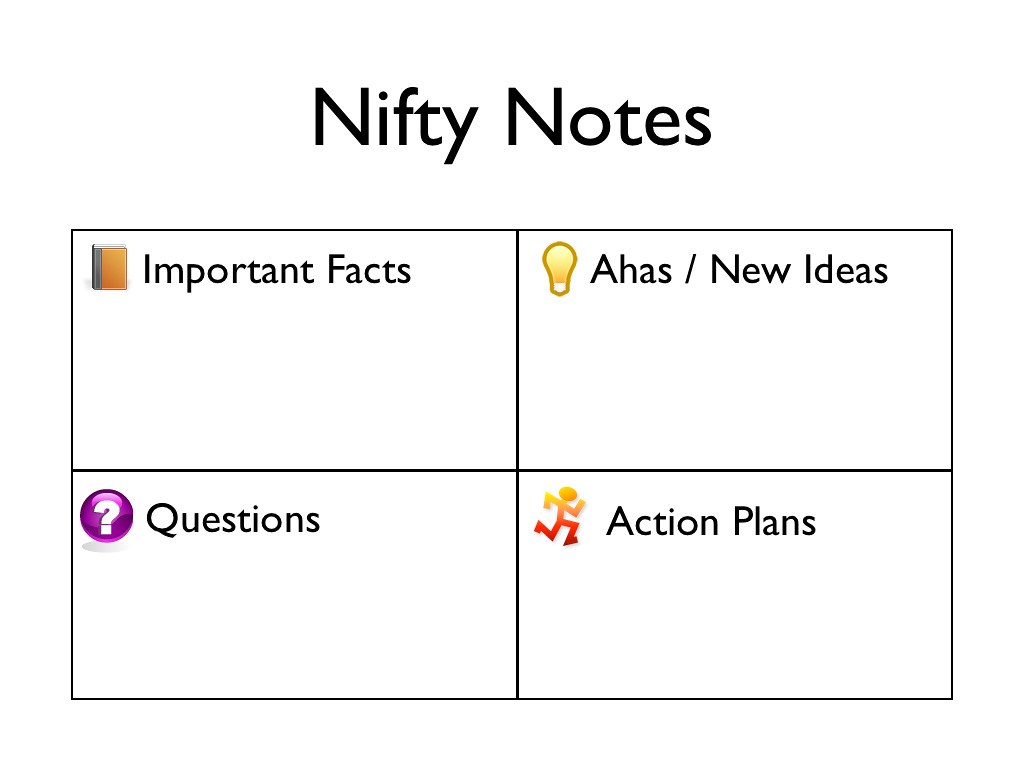
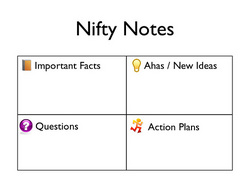
Note taking sheet
Learning to take notes requires the same focus and attention as learning to highlight text. Teachers use strategies such as the New AmericanLecture, Cornell Notes, and a host of others to help students learn how to take notes effectively. I find that I have to continually remind students to use organizers when taking notes. In middle school, I often give students organizers that have three bullets in each of four boxes. Students are instructed not to exceed three bullets.  Other times, I will use up to five bullets. The point is that students need note taking parameters. Left to their own devices, I agree with Mueller and Oppenheimer, students will mindlessly transcribe.

Part of my curriculum involves students taking notes while viewing videos. In order to reduce the temptation to transcribe the video, I send the students a link to a video transcript. They immediately understand they do not need to retype the transcript. It is available to them anytime they need it. Teaching note taking requires the same skills as teaching any other concept. Students need an introduction, opportunity to practice, and some form of feedback loop.
The question Mueller, Oppenheimer, and McGloin should have asked their college students is what note taking method they used and why they chose it. When I ask seventh graders this question, many reply they have no organized method, they just write bullets. I teach at least three methods of taking notes in my class. We begin with Cornell, outline, and mind mapping (mapping.)  I review which methods helped students and by the end of the year, I ask them to choose the method they have found the most helpful.
Students do not automatically remember these methods from year to year or class to class or even unit to unit within the same class. The temptation to revert to a new bullet for every note and mindlessly transcribe is often too great to resist. The reason note taking methods, even just longhand, work is that students have to mentally analyze and evaluate information prior to writing/typing it. Every teacher from middle school to university needs to instruct and remind students how to take useful notes.

Taking notes on a laptop is far more useful than longhand if taught and practiced correctly. Laptop notes can be annotated, tagged, re-used, shared with study groups, and, when cited correctly, become the basis for research articles, class papers, and essays. Electronic notes also encourage reorganizing, further research, etc., that both enhance and extend learning. Part of my teaching note taking methods involves students coming to class with at least three questions generated from their notes. These become the basis for a quick review/discussion. Muller’s and Oppenheimer’s study do not indicate any follow up other than a quiz.


Longhand notes might work well in the short term, either for a unit or a single class. Electronic notes will last longer and be far more useful provided students are taught/reminded that there has to be a method to their note taking. Mindless transcription is not a method, just as mindless text highlighting is not actively reading. Students should be explicitly coached how to take notes and encouraged to use the methods they have learned.  Pam Mueller agrees and, in a follow up interview, concludes, “Ultimately, the take-home message is that people should be more aware of how they are choosing to take notes, both in terms of the medium and the strategy.”  The question isn’t pixel or pen. It is which note taking method will help me learn and retain this material?


Image sources:
Keyboard & Pen
Nifty Notes
What's so Simple about Note-Taking
Keyboard toolbox


Tuesday, March 11, 2014

Today we learned about the Civil War

Part of the Revolutions! unit involves students planning and teaching an activity related to the time period 1600-1920.  Today, three boys treated us to a lesson on Civil War weapons.  Reenactors of the world would be proud.  After a brief deck explaining a bit about weaponry including a rather graphic reenactment of Lincoln's assassination, the boys led the class on a field trip.  At each stop, they had set up a display of rifles or pistols or cannons.  Then, we were led to the Fir Grove where the boys had set up a target, had brought nerf weapons from home and baked mock apple pie for us to enjoy.  It was a glorious way to spend a sunny morning.  Enjoy the pics!


Sunday, February 2, 2014

A Year of Change

According to Google, it has been nearly I year since I last posted.  What a year it has been.  In that year, I have tweeted over 400 times.  For so many reasons, I prefer Twitter right now.  There have been a few things rattling around in my brain, and, as Will Richardson probably said once, "Just write it."  I know realize I have a lot to write about, so, look for a few posts closely spaced in the next month or so.  I'll begin with my attempt to move to an all-electronic classroom.

This past summer, I was talking with a friend, and I pulled my phone out of my pocket and asked the question, "What if all the information one needed were accessible from this device?"  My friend and I started laughing.  All the information one needs IS accessible from my phone.  Then I began thinking about how my teaching needed to change.  I informed my division head I would be reserving a cart of laptops for my World Cultures class every period, every day.  Next, I discussed with my ultra-talented IT Director the idea of allowing kids to personalize laptops by assigning them to particular students.  We agreed that since most information would be kept in the Googlesphere, it was easier, from a management standpoint, to keep laptops generic.  Given the middle school proclivity towards ownership, I assigned laptops anyway to discourage kids from using laptops as social bait (I call Orange Papa!)

And, so began the year.  If a word comes up in discussion that kids don't know, somebody looks it up almost before I can ask what the word means.  No more passing out papers, documents are shared with classes either when I create them or just prior to the beginning of class.  No child has ever shown up and asked for another paper or has had to dig through a notebook looking for the elusive assignment.  Completed projects and project pieces have been shared with me.  I comment on them and email students that they should check the comments.  The change was seamless and appropriate.

Ah, I hear you cry.  There must be a dark side.  Of course there is.  I teach seventh graders.  Google's fabulous chat feature, so useful for adults, is candy for seventh graders.  It is very hard for kids to type questions into chat while simultaneously listening to a discussion.  If any reader has successfully integrated chat into their teaching, please let me know.  I'd love to hear the stories.  Students also struggle with naming conventions.  Students who turn paper in with a proper MLA heading share online documents with only generic names, making it difficult for me to track their work.  Next year I will insist on a shared folder with the student's name in which all work is shared.  That will help my work flow, and, I suspect organize life bit more for students.


The highlight of the year so far was FAME, Feudal Asia/Medieval Europe.  Electronic research was accomplished using EasyBib.  Kids navigated notecards and work has never been so properly cited.  The presentations themselves were not overly slide heavy. Most students know that paper posters, models, acting, etc are far more effective than watching slide presentations.  Students took notes on laptops the first two days.  The group that presented on day 3, having realized what a distraction that was agreed among themselves to upload and share all of their research and notes.  It was a paradigm shift.  Students focused on the presentations themselves, not on trying to take notes; knowing that all the information they were taking in was already uploaded and could be accessed from anywhere.  For the FAME Final Fling (Test is so anxiety inducing,) I used a Google Form scored by Flubaroo, allowed full and open access to the Internet, and allowed kids to organize their notes anyway they wanted.  An enterprising young student created a 65 person study group and invited his class to contribute.  While most students took the idea seriously, there were a few social issues that arose, and we eventually suggested the student make his document view only.  Next year, I will probably suggest smaller study groups and may even assign them.

At the halfway point in the year, I am excited to continue the paperless experiment, am still having fun teaching, and think I may even begin blogging more regularly.  Thanks for being patient and allowing me to enjoy a posting pause.  Next on the horizon?  Preparing a Puppet Pals tutorial!

Friday, October 29, 2010

Teacher as Learner

Somewhere in the back of my mind I think I have already written a post with this title.  If so, I may consider adding "Again."  In the beginning of ERIC, the 7th grade ancient civilizations project (Egypt, Rome, India, China) students have blogged three topic choices to me (Family Life, Religion, History, etc.) and I have then assigned topics.  This year I decided that group leaders, students elected by their peers, should have a hand in topic assignments.  The methods the groups came up with were fascinating.  One group blogged their choices, but the leaders asked me to email my topic assignments to them for final approval (fortunately for me, they approved my suggestions!)  One group passed out slips of paper in class, had everybody write their choices on them, then asked me to assign topics, again pending their approval.  The last two groups took a different tack.  Their group recorders, also an elected position walked around to every student, asked what they wanted and wrote it down.  If a topic had been taken by a previous student, students simply self-selected another topic.  There was no arguing, nobody wanted to switch at the end.

The empowerment the group leaders and the classes felt was palpable.  Students clearly could not believe a teacher was letting them choose what area they wanted to study.  Two classes didn't want me involved in the process at all.  Did I mind?  Nope, not at all.  Allowing kids to choose what they will study is a huge part of my project-based curriculum.  Was it easy to let go and not try to "engineer" who studied which topic?  It was surprisingly easy.  Next week we will begin research, students have their topics, and I have learned an important lesson about teaching leadership.  Weiden + Kennedy, the Portland advertising agency were right, "Just do it!"

Tuesday, October 12, 2010

What I Learned in School Today

There is a quote in my classroom.  It reads
Creativity is not just for the artist or the gifted.  It is for people.  It is a way of working, a way of thinking, a way of living.

Today, Nikki showed me she lives that quote.  Nikki is in an eighth grade media production class currently involved in creating movies based poems.  The poems were written by students NOT in the class.  The students in the class chose a poem to bring to life.  Nikki, in the midst of setting up her shot, was drawing stick figures on a rainbow.  She was using a dry erase marker.  Ever aware of resource use, I suggested she use a Sharpie which is considerably less expensive than a white board marker.  She replied she had CHOSEN the dry erase marker because she was going to have to erase the stick figures as she filmed.  Puzzled, I asked how she was going to erase the stick figures off the rainbow she had colored.  She explained she wasn't actually drawing on the rainbow, she had placed Scotch Magic tape on the rainbow and then demonstrated how easily the dry erase marker could be erased!  Truly inspired creativity!